Category: Webinar
WATCH: Geospatial monitoring and forest crime
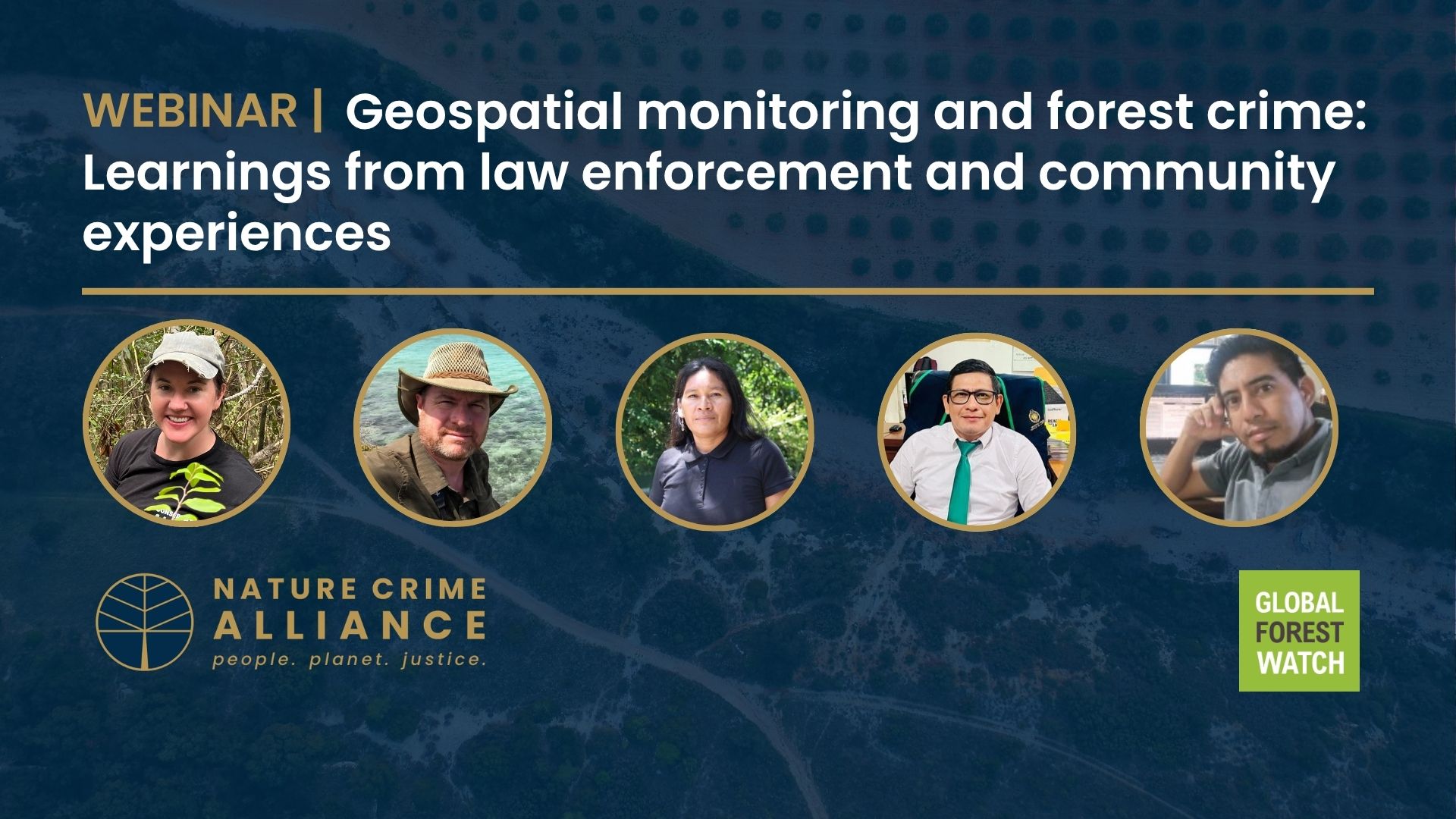
The Nature Crime Alliance brought its members and more than 450 stakeholders together for an information exchange on how geospatial monitoring technologies can counter forest crimes.
Held in partnership with Global Forest Watch, the session showcased perspectives from law enforcement, Indigenous communities, governments, and civil society on the role of these technologies – which use satellite imagery to monitor changes to the Earth’s landscape – in tackling crimes such as illegal logging and illegal mining.
Enforcement efforts in Madagascar
Caitlin Eschmann, Executive Director of Conservation Allies, a member of the Nature Crime Alliance, shared examples from Madagascar, where they work with law enforcement and community partners to identify deforestation in Protected Areas using Global Forest Watch data, and organise interventions. This includes the creation of ‘conservation brigades’ that are having a positive impact in protecting forests in the country. In the Menabe Antimena Protected Area, where conservation brigades operate, deforestation fell by more than 50% between 2023 and 2024, Caitlin said.
Caitlin was joined by Paul Salaman, President of Conservation Allies, for a Q&A session with the audience in which they shared insights from Conservation Allies’ success. The organisation now publishes an annual report on the state of Protected Areas in Madagascar to help policymakers and funders understand the situation on the ground. They are interested in expanding this approach to other geographies. Read the Madagascar Protected Areas Outlook here.
Community and prosecutor experiences in Peru
The focus then turned to Peru, with perspectives from Betty Rubio, Technology Transfer Specialist with the Organisation of Indigenous Peoples of the East (ORPIO), Peru. Betty spoke about the range of information collected by geospatial monitoring that can indicate potential harm to Indigenous territories, which is then passed on to enforcement authorities. This enables immediate action against threats.
Participants also heard from Bratzon Torres Saboya, Adjunct Provincial Prosecutor, Specialized Bureau on Environmental Crimes, Public Prosecutor’s Office of Peru, who discussed how geospatial data is combined with other intelligence, including information gathered in collaboration with the air force, to identify and disrupt criminal actors threatening the Peruvian Amazon.
Innovative uses in Guatemala
The session concluded with insights from Danger Gomez, Head of Geospatial Information Systems, National Forest Institute (INAB) of Guatemala, who discussed how INAB uses deforestation alerts based on geospatial data to identify potential breaches of conservation incentive schemes. Danger discussed the automated system INAB has built to facilitate this monitoring across Guatemala’s forests.
The webinar brought together more than 450 representatives from governments, law enforcement, Indigenous communities, philanthropies, and civil society to learn from our speakers’ experiences. It was moderated by Ruth Nogueron and Luke Foddy and was produced by Isabela Barriga, World Resources Institute.
WATCH THE SESSION IN FULL (ES and FR versions below)
English version
Versión en español
Version française
WATCH: Meet the Nature Crime Alliance #5
The challenge of nature crime in Peru and the different approaches to tackling wildlife crime in Africa were explored during the fifth edition of the Meet the Nature Crime Alliance webinar series.
Deforestation and illegal mining in Peru
Dr Frank Robert Almanza Altamirano, National Coordinating Senior Prosecutor at the Specialized Environmental Prosecutor’s Office, Government of Peru, joined the session to discuss how types of nature crime are threatening Peru’s rich biodiversity.
Speaking with Ruth Nogueron, Senior Associate in the Forest Program at World Resources Institute, Dr Almanza highlighted illegal deforestation and timber trafficking as key challenges, alongside illegal gold mining. The increase in the value of gold has driven a rise in informal and illegal mining in Peru, Dr Almanza said. These mining activities also have a devastating impact on forests.
The prosecutor also outlined the policy approaches that are needed, such as legislation to close legal loopholes used by criminals to plunder nature. Dr Almanza also highlighted how aspects of political power can present a challenge to prosecuting nature crime cases.
Tackling wildlife crime in Africa
The network also heard from Shawn Karns, a Founding Director of the Wildlife Investigators Training Alliance (WITA), where he also serves as Director of Investigations and Trainings.
Shawn gave an overview of the state of wildlife crime across Africa, and discussed WITA’s approach to tackling the issue – particularly its focus on value chains. WITA trains rangers and investigators together, not in isolation, in order to build connections, relationships and trust between the actors involved at different stages of wildlife crime prosecutions. This bolsters the “criminal justice value chain”, Shawn said.
The importance of putting pressure on the wider networks involved, rather than targeting just poachers, was also highlighted.
Shawn also spoke of the value of partnerships and collaboration – including initiatives like the Nature Crime Alliance – and the need to eradicate silos among stakeholders fighting wildlife crime.
Watch in full
These webinars serve as a platform to share knowledge and best practice among the Alliance network. By bringing actors from different sectors together, we can spark new ideas and foster opportunities for collaboration.
You can watch the session in full below (Spanish and English versions available).
English version
Versión en español
If your organisation is a member of the Nature Crime Alliance and you’d like to share insights with our network through this platform, please contact luke.foddy@wri.org
WATCH: Meet the Nature Crime Alliance #4
The illicit trade in Myanmar teak and a new resource to tackle financial crime linked to environmental crime were some of the issues explored in the latest ‘Meet the Nature Crime Alliance’ webinar.
Marcello De Maria, Project Manager, WWF-UK, unpacked the recently-launched Environmental Crimes Financial Toolkit – an online platform that assists financial institutions in monitoring risks related to nature crimes such as illegal deforestation, land conversion, and wildlife trafficking.
Julian Newman, Campaigns Director, and Kate Klikis, Forests Campaigner, Environmental Investigation Agency, highlighted how Myanmar teak – a highly sought-after timber used for furniture and luxury yacht decking – continues to enter the US and EU markets despite measures to prevent this illegal trade.
And Tsveti Bandakova, Programme Manager, Nature Crime Alliance Secretariat, provided a preview of a new suite of resources that have been developed by the Alliance team to support members’ activities in tackling nature crime.
The session also heard from Charles ‘Chip’ Barber, Director of the Nature Crime Alliance, who shared highlights from a new World Resources Institute report he has co-authored: ‘People, Planet, Justice: Understanding and Countering Nature Crime‘.
Learn more about our members’ work
If you’d like to find out more about the work showcased during the webinar, you can contact the speakers directly:
Marcello De Maria: If you’d like to learn more about WWF’s Environmental Crime Financial Toolkit, please contact Marcello at: MDeMaria@wwf.org.uk
Julian Newman and Kate Klikis: To find out more about the Environmental Investigation Agency’s work on Myanmar teak, please contact Julian at: JulianNewman@eia-international.org or Kate at: katarinaklikis@eia-international.org
The video they included in their presentation can be viewed here.
Tsveti Bandakova: To learn more about the resources developed by the Nature Crime Alliance Secretariat, please email Tsveti at: tsvetilena.bandakova@wri.org
Chip Barber: Chip also authored a WRI Insights piece here, which distills key aspects of the report. You can contact Chip at charles.barber@wri.org
Join a future webinar!
If you’re a member of the Nature Crime Alliance and would like to be profiled in a future webinar, please contact Luke Foddy: luke.foddy@wri.org
WATCH: Civil Society and COP16: How can organisations make the most of the CBD COP?
The upcoming Conference of the Parties of the UN Convention on Biological Diversity (CBD COP) in Cali is a major opportunity to make global progress on protecting nature. But as with all high-level international fora, the CBD COP has its fair share of complexity.
Based on discussions with members of the Nature Crime Alliance – some of whom are engaging with the CBD process for the first time at COP16 – the Alliance Secretariat convened a webinar to help civil society organisations better understand how the CBD COP works, and provide advice on how to make the most of their participation in this key global summit.
Dr Susan Lieberman, Vice President, International Policy, Wildlife Conservation Society, and Dr Chip Barber, Director, Natural Resources Governance and Policy, World Resources Institute, shared insights from their deep experience in engaging with the CBD process.
Watch the webinar in full
For more information, please contact Luke Foddy, Communications Manager: luke.foddy@wri.org
WATCH: Meet the Nature Crime Alliance #3
The UN Office on Drugs and Crime (UNODC) and World Forest ID shared insights from their work during the latest ‘Meet the Nature Crime Alliance’ webinar on Thursday 3 October.
Covering issues across wildlife crime, timber traceability, and the global landscape of criminalisation for environmental offences, the webinar brought members of the Nature Crime Alliance together to share information and ideas.
Watch the webinar in full
Tanya Wyatt, Lead Researcher, Crimes that Affect the Environment, UNODC, unpacked highlights from the Landscape of Criminalization report, part of the Global Analysis on Crimes that Affect the Environment.
Katalin Kecse-Nagy, Wildlife Crime Research Officer, UNODC, shared highlights from the 2024 World Wildlife Crime Report, including some of the solutions that are working in the fight against these crimes.
Jade Saunders, Executive Director of World Forest ID, provided updates on the non-profit’s science-based traceability efforts, including some good advice for organisations seeking to build relationships with law enforcement.
Moderated by Luke Foddy, Communications Manager, Nature Crime Alliance, the session also included remarks from Dr Chip Barber, Director, Natural Resources Governance and Policy, World Resources Institute.
Learn more about our memebers’ work
If you’d like to find out more about the work showcased during the webinar, you can contact the speakers directly:
Tanya Wyatt: tanya.wyatt@un.org
Katalin Kecse-Nagy: katalin.kecsenagy@un.org
Jade Saunders: jade.saunders@worldforestid.org
If you are a member of the Nature Crime Alliance and would like to be featured in a future webinar, please contact Luke Foddy: luke.foddy@wri.org
WATCH: Meet the Nature Crime Alliance #2
The online ivory trade in the EU, illegal gold mining in the Amazon, and the role of US transnational whistleblower laws in fighting environmental crime were all explored during the second edition of the ‘Meet the Nature Crime Alliance’ webinar series.
Eugénie Pimont, Wildlife Cybercrime Officer at IFAW, presented findings from the recent report, ‘The Elephant in the Net: Research snapshot of the online ivory trade after the adoption of the new EU rules’, which highlights how ivory is still being widely sold in several European countries despite tougher rules being introduced across the EU in 2022 aimed at limiting the trade. Eugénie’s presentation (see slides here) was a stark reminder of the challenges posed by online marketplaces in the context of nature crime – something the Alliance is focusing on in its supply chain choke points workstream.
If you’d like to know more about IFAW’s work in this area, you can reach Eugénie at: epimont@ifaw.org
Turning to South America, Matt Finer and Nadia Mamani from Amazon Conservation Association shared insights from their ‘Monitoring the Andean Amazon Project (MAAP), with a focus on illegal gold mining in Peru. Matt, the Director of MAAP, showed that gold mining in the region takes place in several different contexts, while Nadia, Senior GIS and Remote Sensing Specialist, provided insights on how Amazon Conservation is working with local communities to bring their findings to the attention of law enforcement. You can reach Matt and Nadia at: mfiner@amazonconservation.org and nmamani@amazonconservation.org respectively.
The session also heard from Steve Kohn, Founding Partner at KKC and Chair of the National Whistleblower Center, who shared his perspectives on how existing US transnational whistleblower laws can be used for effective nature crime enforcement. Steve stressed the value of these laws in prosecuting and deterring perpetrators of nature crime, but noted that this value is widely unknown among many stakeholders. This includes the potential funding available for CSOs through successful prosecutions and sanction revenue. See Steve’s slides here. Contact Steve at: stephen.kohn@kkc.com.
The ‘Meet the Nature Crime Alliance’ webinar series aims to showcase Alliance members in short, concise sessions that can spark future engagement. This session, which took place on 29 May, also featured an update from the Alliance Director, Yulia Stange.
If your organisation is an Alliance member and you would like to take part in future webinars, please contact luke.foddy@wri.org
Watch the first edition of the webinar series, featuring Earth League International, Wildlife Justice Commission and Sustainable Fisheries Partnership, here.
WATCH: Meet the Nature Crime Alliance webinar
The Nature Crime Alliance Secretariat convened a webinar on Wednesday 20 December to look ahead at the Alliance’s plans for 2024, and to showcase the work of Alliance members who are actively fighting nature crime.
The session heard from three Alliance members who shared insights on their work and the issues they are addressing:
Jenna Robertson, Intelligence Manager, Marine Investigations, WJC, presented findings from WJC’s recent report, ‘Convergence of Wildlife Crime with Other Forms of Organised Crime: A 2023 Review.’
Andrea Crosta, Founder and Executive Director, Earth League International, discussed criminal networks with significant environmental crime convergences.
Braddock Spear, Global Policy Director, North America, Sustainable Fisheries Partnership (SFP), shared the latest on Universal Fishery IDs – a collaboration between SFP and the United Nations Food and Agriculture Organization – to ensure discussion and data-sharing across the seafood industry, governments, NGOs, and other stakeholders to increase transparency and more targeted interventions against crimes associated with fishing.
Yulia Stange, Director of the Nature Crime Alliance, also provided an update on the next steps for the Alliance, including opportunities to engage with upcoming working groups.
If you are an Alliance member and would like to take part in future webinars, please contact luke.foddy@wri.org