Alliance Newsletter | Summer 2026
Tools to tackle forest crime, exploring a potential new UNTOC protocol, engaging the private sector + more
NEWS FROM THE ALLIANCE TEAM
WATCH | Alliance convenes information exchange and training session on using geospatial monitoring to fight forest crime
The Nature Crime Alliance brought more than 450 stakeholders together for an information exchange on how geospatial monitoring technologies can counter forest crimes. Held in partnership with Global Nature Watch (previously Global Forest Watch), the session showcased perspectives from law enforcement, Indigenous communities, governments, and civil society on the role of these technologies – which use satellite imagery to monitor changes to the Earth’s landscape – in tackling crimes such as illegal logging and illegal mining.
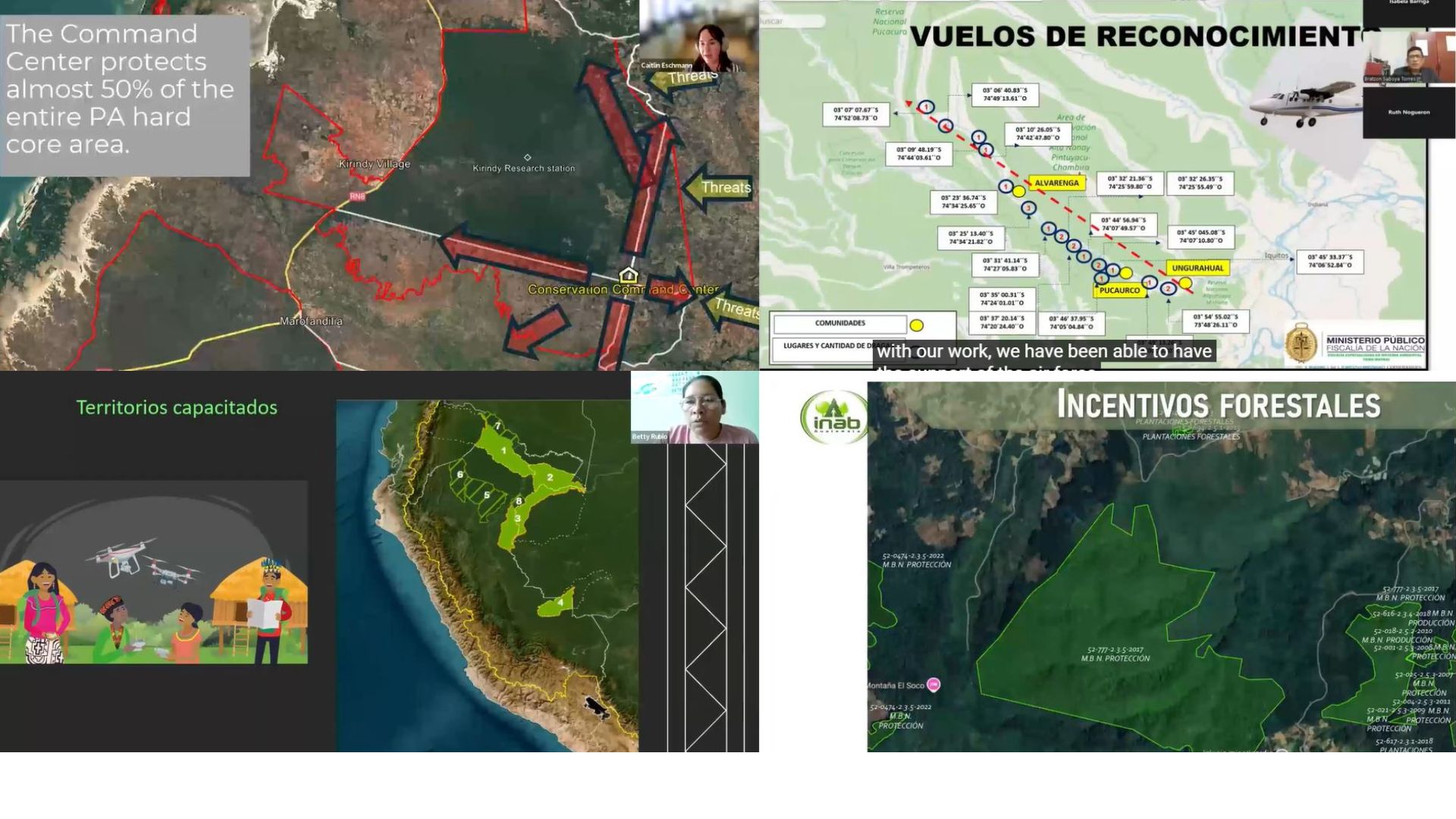
Participants heard insights and learnings from Alliance member Conservation Allies, Peru’s public prosecutor’s office, Guatemala’s National Forest Institute (INAB), and the Organisation of Indigenous Peoples of the East (ORPIO), Peru.
The session is available to watch here in English, French and Spanish. Watch in English below.
Following the geospatial monitoring webinar, the Alliance held a training session on using the Global Nature Watch (GNW) platform to identify, investigate and disrupt forest crime. The session, convened in partnership with GNW, saw experts demonstrate how the geospatial monitoring tool can be used to support efforts to tackle illegal deforestation. Participants included government agencies, civil society organisations, and local communities. The Alliance team are very grateful to the Waterloo Foundation for supporting this work.
Alliance Director joins new IUCN Specialist Group

The Director of the Nature Crime Alliance has joined a new IUCN Specialist Group focused on implementing IUCN Resolution 8.048 on Crimes that Affect the Environment, which was adopted at the World Conservation Congress in October. Dr Charles ‘Chip’ Barber, who serves as Director of Natural Resources Governance and Policy at World Resources Institute (WRI), which hosts the Alliance, has been invited to join the IUCN WCEL Crimes that Affect the Environment Specialist Group, which functions under IUCN’s World Commission on Environmental Law. Chaired by John Scanlon AO, Executive President, International Council of Environmental Law, with Ana Motamayor, Policy Advisor at the Global Initiative to End Wildlife Crime, serving as Deputy Chair, the group brings together a wealth of expertise on environmental crime and conservation.
APAC Dialogue explores environmental crime risk to finance and transport sectors
The latest Asia-Pacific Regional Private Sector Dialogue (PSD) on the disruption of financial crimes related to crimes that affect the environment convened in Kuala Lumpur in May, with representatives from the transport sector joining the discussion for the first time. Organised by the UN Office on Drugs and Crime, INTERPOL, and WRI – which hosts the Nature Crime Alliance – in partnership with United for Wildlife, the PSDs aim to improve the private sector’s understanding of environmental crimes and related risk. The latest Dialogue, hosted by the Asian Development Bank, brought together government representatives from 18 countries, 14 private sector organisations and 13 civil society and academic institutions.
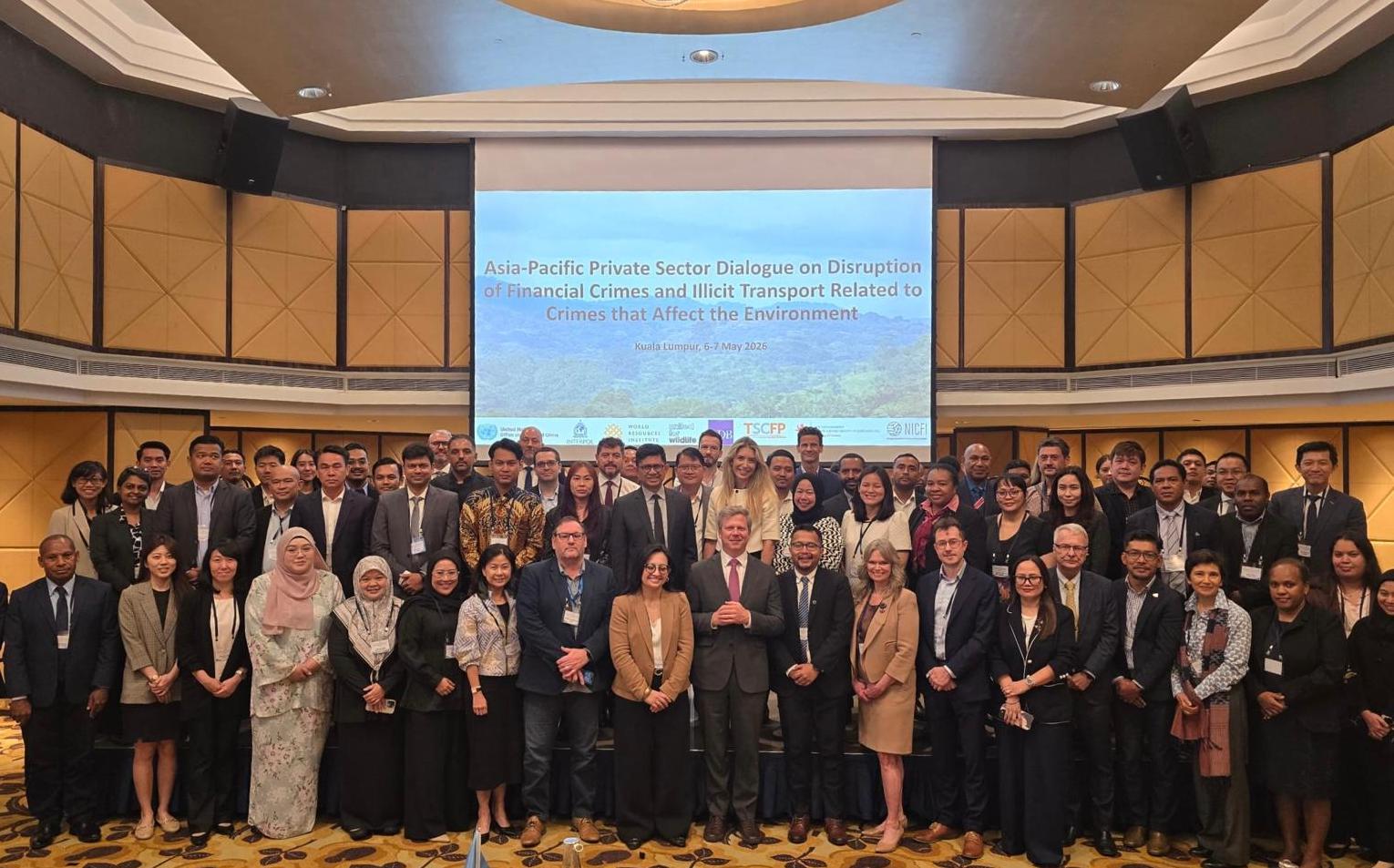
The inclusion of representatives from the shipping and transport sector saw new topics explored in the Dialogue, including methods for improving vessel screening and identifying risk indicators such as high-risk ports, flags of convenience or links to sanctioned entities. The post-session evaluation questionnaire reported that 100% of participants found the Dialogue enabled them or their organisation to identify new risk indicators, red flags and/or suspicious transactions of financial crimes related to environmental crimes, while 88% reported that the inclusion of the transport sector in the Dialogue, alongside the private financial sector, was extremely valuable.
Exploring a potential UNTOC protocol on crimes that affect the environment
Lynn Schlingemann, Senior Associate, Financial Crime and Corruption, WRI, participated in a roundtable discussion in May on a potential new protocol on crimes that affect the environment (CAE) under the United Nations Convention against Transnational Organized Crime (UNTOC). Organised by the Dutch Ministry of Justice and Security and the Permanent Mission in Vienna, the session brought together policy officers and experts from a range of organisations, including Alliance members Wildlife Justice Commission and Wildlife Conservation Society, to discuss such a protocol, which could bring a range of benefits to bolster the global fight against environmental crime.
The UNTOC is the principal international legal framework for combating organised crime, and provides several tools that support law enforcement action. These include mechanisms that enable deeper levels of international cooperation, such as the sharing of financial information to support joint investigations, the provision of technical assistance, and measures to assist in asset recovery. A new CAE protocol would extend the Convention’s operational framework to environmental crimes, enabling its cooperation mechanisms to be applied more consistently across jurisdictions. A key opportunity to drive progress on a new protocol is the upcoming Conference of the Parties to the UNTOC which takes place in Vienna this October.
Find out more about a potential CAE protocol in this GI-TOC podcast featuring John Scanlon AO, Executive President, International Council of Environmental Law, and Frances Craigie, Chief Director, Enforcement, South African National Department of Forestry, Fisheries and the Environment. The Wildlife Justice Commission has published a helpful blog on developments around international legal frameworks, including the UNTOC, which you can read here.
Journalists discuss nature crime investigations at Mongabay’s ‘PUMA FEST’
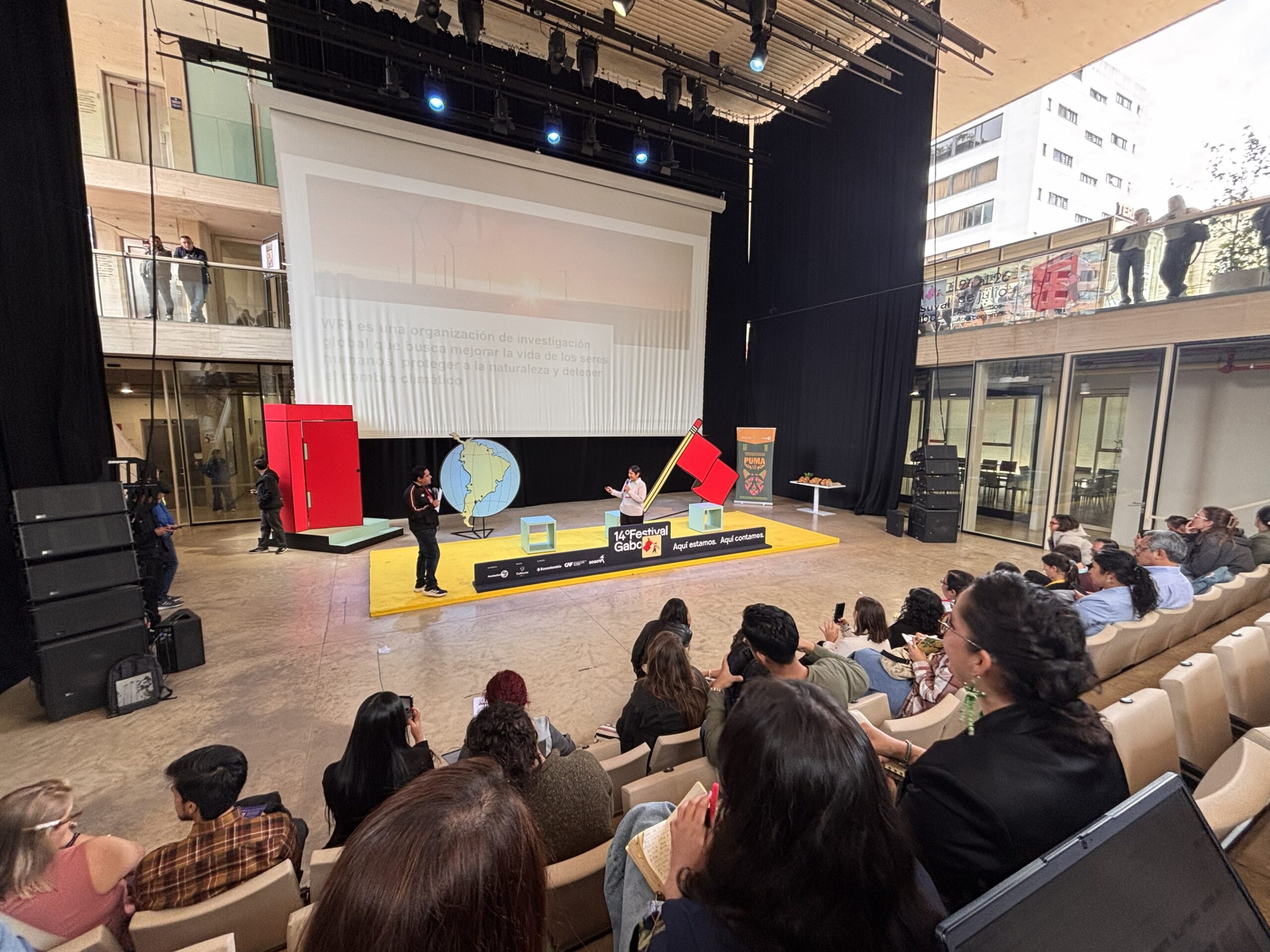
Image: Alexa Velez (Mongabay Latam)
Ruth Nogueron, Senior Associate at WRI, spoke at the PUMA FEST Latin American Environmental Journalism Festival in Bogotá, Colombia, last week, where she demonstrated the power of satellite-derived information and artificial intelligence (AI) in investigating nature crimes. The festival, organised by Mongabay Latam, brought together journalists, scholars, students and other practitioners at the intersection of journalism and environmental issues. Ruth spoke on a panel that explored technologies such as geospatial monitoring and AI, and their application for investigative journalism. She introduced the Global Nature Watch platform and its forest monitoring systems, and shared examples of its use in identifying environmental crimes including illegal logging and illegal deforestation.
Dutch stakeholders briefed on role of open source intelligence in countering illegal timber trafficking and waste crime
The Alliance team presented and participated in two Open Source Intelligence (OSINT) days in the Netherlands focused on waste and pollution crime and illegal timber trafficking. The event brought together representatives from a range of Dutch organisations including the Environmental Protection Agency, Financial Intelligence Unit, tax authority, police, and several banks. Lynn Schlingemann, Senior Associate, Financial Crime and Corruption, WRI, presented work under the EU ENCORE project on risk indicators linked to corruption and waste and pollution crimes. Additionally, Sarah Carter from Global Nature Watch, WRI, presented on how satellite imagery combined with financial and trade data may help identify deforestation risks and high-risk supply chains.
WATCH | Webinar unpacks findings from forest legality project in Cameroon
From 2021 to 2026, WRI, together with Centre pour l’Environnement et le Développement, Forêts et Développement Rural and Field Legality Advisory Group, implemented a project, supported by the European Union, to strengthen transparency in forest operations and improve forest legality in Cameroon through independent forest monitoring. A recent webinar shared learnings from the project, which identified several challenges in the country. These include insufficient numbers of enforcement agents to cover mangrove areas, lost tax revenues linked to illegal logging, and examples of suspicious company activities. The need for cross-sector collaboration and efforts to build trust were also explored in the webinar. Read a summary of the session on the Forest Governance and Policy website.
Use YouTube Settings icon in video to select English or French audio
Guidelines on productive collaboration between civil society and law enforcement
The recent announcement of a new partnership between IUCN and the UN Office on Drugs and Crime to tackle environmental crime (see ‘News from our Network’, below) highlights the value of multi-sector approaches to this complex challenge. In December, the Alliance team, in collaboration with the INTERPOL Wildlife Crime Working Group and United for Wildlife, published a set of Guidelines to support productive collaboration between civil society organisations and law enforcement on environmental crime.
Analysis: Science is giving forest law enforcement a new edge
A recent WRI Insights article explores how traceability technologies promise to transform law enforcement approaches to illegal timber. Centered on examples from Indonesia, the article highlights how forensic wood identification techniques such as DNA and isotope analysis can identify the precise origin of timber, enabling authorities to verify claims in logging documentation as to the source of forest products.
NEWS FROM OUR NETWORK
Small grants opportunity for projects that advance the global 30×30 target
The High Ambition Coalition for Nature and People (HAC for N&P) has launched its Second Cycle of the Rapid Deployment Mechanism (RDM), a small grants programme supporting developing country members in advancing the global 30×30 target. In its first edition, the RDM awarded 10 grants of up to $50,000 to projects in Ghana, Kenya, Colombia, Maldives, Peru, Burkina Faso, Thailand, Malawi, Cook Islands, and Madagascar. These projects supported actions such as protected area designation, spatial planning, identification of OECMs, community-led conservation, and strengthening protected area management.
Supported by the Earthshot Prize and British Airways, the HAC for N&P, which is hosted by World Resources Institute and the Global Environment Facility, will award 10 grants ranging from $25,000 to $50,000, with successful applicants announced at COP17 in October 2026. Find out more
Taskforce on Nature Related Financial Disclosure (TNFD) seeking inputs on environmental crime guidance
The Taskforce on Nature-related Financial Disclosures (TNFD) is holding an open consultation on a draft paper that presents guidance on incorporating environmental crime considerations into organisations’ nature-related dependencies, impacts, risks and opportunities. TNFD has published a Discussion Paper that explores a range of environmental crimes, including illegal mining, illegal fishing and wildlife trafficking, and are seeking inputs from stakeholders. The consultation closes on 7 August 2026. View the Discussion Paper
IUCN and UNODC launch strategic partnership on crimes that affect the environment
IUCN and the United Nations Office on Drugs and Crime (UNODC) have launched a strategic partnership agreement to deepen cooperation in tackling crimes that affect the environment. The partnership, announced in June during the United Nations High-Level Meeting on Crimes that Affect the Environment at UN Headquarters in New York, aims to bridge the gap between conservation science and international criminal justice, addressing crimes such as wildlife trafficking, illegal logging, and fisheries crime. The IUCN US National Committee produced a good read out from the New York meeting here.
WWF and IFAW contribute to new guidance aimed at bolstering European environmental crime strategies
Alliance members IFAW and WWF are among several organisations to produce new guidance to help EU governments develop and execute effective national strategies to fight environmental crime. The guidance includes practical recommendations for governments preparing their national strategies, from designing science based approaches to recommendations for monitoring and reporting. View the Guidelines here
ELI’s Operation SANDOKAN reveals major wildlife trafficking networks across the Lower Mekong
Earth League International (ELI) has exposed wildlife trafficking networks in Cambodia with links across the Lower Mekong during a major undercover investigation. In a new report – Operation SANDOKAN: Unmasking the Lower Mekong’s Biggest Wildlife Traffickers – ELI documents undercover intelligence operations that reveal the scale of the illegal wildlife trade across Southeast Asia, the criminals who run it, and the corruption that sustains it. ELI has also produced a short film based on the operation to accompany the report. Read more
IFAW report highlights surge in online sales of primates in the US
A recent report from IFAW, developed with AZA and WWF, reveals how fragmented laws, inconsistent enforcement, online platform loopholes, and the normalisation of primates as pets are fueling demand for wildlife exploitation. Alongside documenting the scale of the trade, the ‘Primates for Purchase‘ report outlines practical recommendations for policymakers, enforcement agencies, digital platforms, and the public to help reduce demand, strengthen protections for primates, and improve responses to wildlife trafficking and confiscation. Read the report
WFID publishes key findings from farmed shrimp research
World Forest ID (WFID) has published a new peer-reviewed paper on how chemical testing can be applied to farmed shrimp, supporting transparent supply chains, sourcing integrity, and responsible producers. The paper follows a WFID investigation, published in April, into farmed shrimp, which found that many products sold in supermarkets do not match their declared origin. Read the latest paper
Applications open for virtual media workshop on forest governance
Earth Journalism Network is hosting a two-day virtual media workshop in October on forest governance, primarily aimed at journalists from Ghana, Liberia and Cameroon. Journalists from forest risk commodity consumer markets in Europe and Asia (such as the European Union, United Kingdom, China and India) are also encouraged to apply. The workshop, which convenes on 21-22 October, aims to strengthen journalists’ knowledge of forest governance issues and improve their reporting on challenges and solutions in sustainable forest management. The deadline for applying is 13 August. Find out more and apply here
Want to get the Nature Crime Alliance newsletter direct to your email? Sign up to our mailing list to receive the latest updates.

Keep Informed
Subscribe to Our Newsletter
Sign up here to receive news, analysis and event updates from the Nature Crime Alliance.