Strengthening Environmental Crime Journalism: Insights and Recommendations from a Global Training
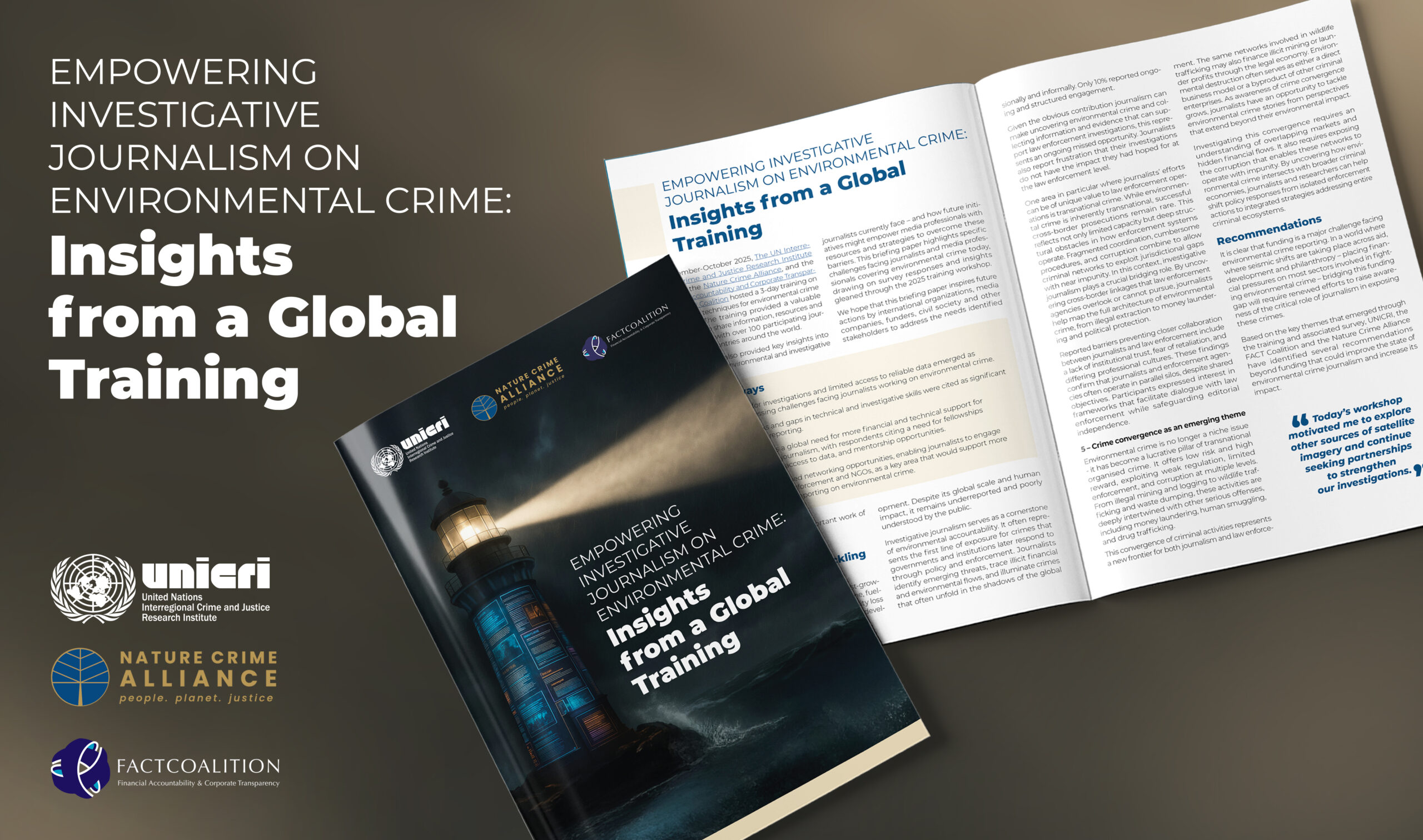
A new briefing paper released by the Nature Crime Alliance and our members the United Nations Interregional Crime and Justice Research Institute (UNICRI) and the Financial Accountability and Corporate Transparency (FACT) Coalition sheds light on the key challenges facing investigative journalists reporting on environmental crime worldwide — and outlines practical recommendations to strengthen the field.
Empowering Investigative Journalism on Environmental Crime: Insights from a Global Training, draws on discussions and survey findings from a specialised training workshop held from 29 September to 1 October 2025. The workshop brought together more than 110 journalists and communications professionals from across the globe to deepen their understanding of environmental crime, investigative techniques and crime convergence dynamics.
A growing threat, an urgent need for action
Environmental crime has become a lucrative pillar of transnational organised crime, driving deforestation, pollution and biodiversity loss while undermining governance and sustainable development. Yet it remains underreported and poorly understood by the public.
Investigative journalism plays a critical role in exposing illicit networks, tracing financial flows and uncovering systemic weaknesses that enable environmental crime to flourish. The new briefing highlights how journalists are often the first to reveal crimes that later prompt policy and enforcement responses.
However, the report identifies significant structural and operational barriers that limit the impact of environmental crime reporting.
Key findings
Based on responses from participants, the briefing identifies several recurring challenges:
– Limited access to reliable and affordable data, including scientific datasets and high-resolution imagery
– Insufficient funding for in-depth investigations
– Personal safety risks and the need for stronger digital security training
– Limited structured cooperation between journalists and law enforcement agencies
– The growing complexity of crime convergence, where environmental offences intersect with financial crime, corruption and other illicit activities
The findings suggest that demand for financial and technical support continues to outstrip available opportunities, particularly in relation to fellowships, grants and access to investigative tools.
From training to action
The briefing builds on a three-day online workshop convened by the Nature Crime Alliance — hosted by the World Resources Institute — in partnership with UNICRI and the FACT Coalition. The training featured contributions from experts in environmental enforcement, financial transparency, satellite monitoring and investigative reporting.
Through expert lectures, case studies and practical sessions, participants explored how to investigate environmental crime in complex and restricted contexts, including through the use of satellite imagery, open-source intelligence and financial analysis. Insights gathered during the training informed the report’s recommendations, which include:
– Establishing a centralised environmental crime data platform
– Developing guidelines to facilitate collaboration between journalists and law enforcement
– Creating cross-sector networks to promote information exchange and capacity-building
Strengthening accountability through journalism
At a time of significant shifts across global aid, development and philanthropic funding landscapes, the report underscores the importance of sustained investment in environmental crime journalism. Strengthening investigative capacity, improving access to data and fostering cross-sector dialogue are essential to ensuring that environmental crime is exposed and addressed effectively.
By equipping journalists with the tools, partnerships and institutional support they need, the international community can reinforce accountability and contribute to more effective responses to environmental crime. Personal safety risks and gaps in technical and investigative skills were cited as significant barriers to effective reporting.
The survey highlights a global need for more financial and technical support for environmental crime journalism, with respondents citing a need for fellowships and grants, improved access to data, and mentorship opportunities.
Participants also identified networking opportunities, enabling journalists to engage with experts from law enforcement and NGOs, as a key area that would support more accurate and impactful reporting on environmental crime.
READ THE PAPER
Keep Informed
Subscribe to Our Newsletter
Sign up here to receive news, analysis and event updates from the Nature Crime Alliance.