Alliance Secretariat shares perspectives on environmental crime progress at the international level
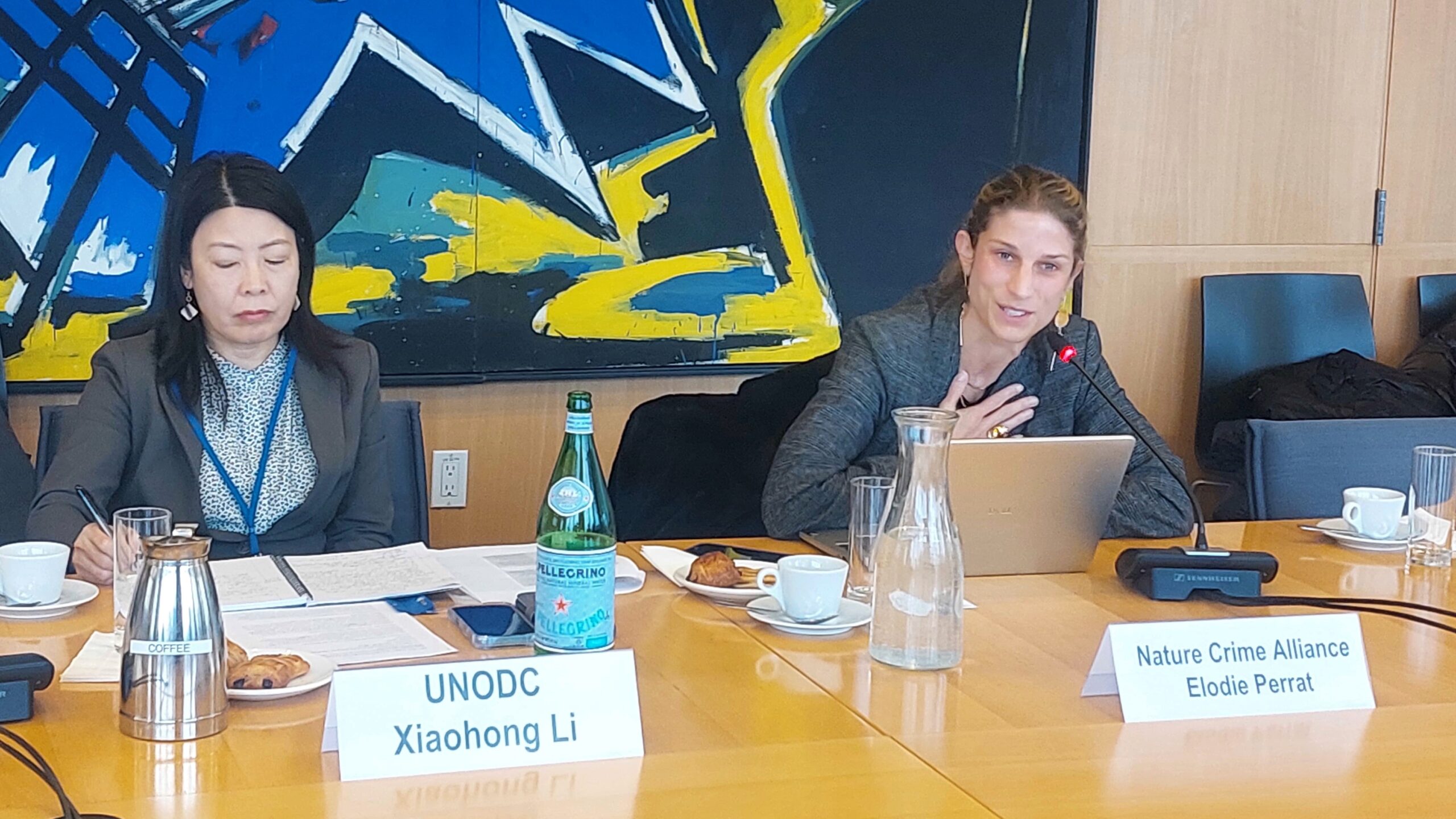
The Nature Crime Alliance Secretariat briefed a range of government and civil society stakeholders on the international momentum being built to tackle environmental crime.
Elodie Perrat, Senior Manager, Nature Crime Alliance, spoke at ‘The State of Play on Crimes Affecting the Environment: Opportunities for a Collective Response’, co-organised by France, IUCN, Wildlife Conservation Society (WCS), Germany, and Brazil, and hosted at the Permanent Mission of Germany to the UN in New York.
Elodie, who serves on the IUCN US Committee, highlighted how the issue of crimes affecting the environment (CAE) is gaining traction across international fora, with discussions taking place at the UN General Assembly, the UN Convention against Transnational Organized Crime (UNTOC), the UN Convention Against Corruption (UNCAC), the Convention on International Trade in Endangered Species of Wild Fauna and Flora (CITES), the UN Environment Assembly (UNEA), and the IUCN World Conservation Congress.
The challenge now is connecting these discussions and translating momentum into coordinated action.
Political will is building
Despite recent setbacks, such as the withdrawal of a resolution on CAE at UNEA-7, there is clear interest among states to do more on this issue, as the discussion – chaired by Sofie Jaffe, IUCN’s Permanent Observer to the UN – highlighted.
Ambassador Norberto Moretti, Deputy Permanent Representative of Brazil to the UN, shared information about the new Coalition for Multilateral Action Against CAE launched in Rio ahead of COP30, while Thomas Zahneisen, Deputy Permanent Representative of Germany to the UN, reaffirmed Germany’s leadership on wildlife crime through the Group of Friends on Poaching and Illicit Wildlife Trafficking.
Elodie shared her thoughts on the resolution on crimes affecting the environment adopted at the IUCN World Conservation Congress in October – a landmark moment in getting environmental crime firmly on the conservation agenda. The resolution was the outcome of cooperation between a range of stakeholders, including France, WCS, National Whistleblower Center, ICEL, and the World Resources Institute through Elodie’s work with the Nature Crime Alliance.
Member States to the UNTOC are also considering whether a new protocol on CAE could address persistent legal gaps and strengthen international cooperation. Such a protocol could address some of the current barriers to action against CAE, stated Carlos Alberto Sánchez Del Águila, Minister-Counsellor, Permanent Mission of Peru to the UN in Vienna, and Chair of the UNTOC Open-ended Intergovernmental Expert Group on CAE (IEG).
The lack of a comprehensive global framework, uneven national legislation, and the underuse of financial investigations, asset confiscation, and corporate liability remain key challenges, Xiaohong Li from the UN Office on Drugs and Crime (UNODC) noted.
The essential role of civil society
The crucial role of civil society organisations (CSOs) in complementing state action was also discussed during the session. CSOs support such efforts through their work on coordination, accountability, and evidence-based policymaking.
The role of CSOs in supporting law enforcement investigations on CAE was recently highlighted in new Guidelines published by the Nature Crime Alliance, which aim to bolster information sharing between CSO and enforcement agencies.
Alice Pasqualato, Global Policy Specialist on Environmental Crime at WCS, outlined civil society’s key recommendations for 2026, including leveraging upcoming milestones in 2026, such as the UNTOC IEG’s recommendations and the 15th UN Crime Congress.
Building on successes
The progress made in 2025, including the IUCN resolution, offers a foundation for building stronger collaboration into 2026.
Elodie commented: “We have a clear opportunity to make further progress in 2026 and the Nature Crime Alliance stands ready to work with our members to support this growing multilateral effort. Collective action is not only necessary — it is increasingly within reach.
“I am grateful to have had the opportunity to exchange perspectives and ideas with key partners during this session as we explore how to deepen cooperation on environmental crime at the international level.”
The meeting took place in New York on Wednesday 17 December.
For more information, contact Elodie Perrat at: elodie.perrat@wri.org

Keep Informed
Subscribe to Our Newsletter
Sign up here to receive news, analysis and event updates from the Nature Crime Alliance.